Laboratory of Metabolism of Bioactive Lipids
Content of this page
About the Laboratory
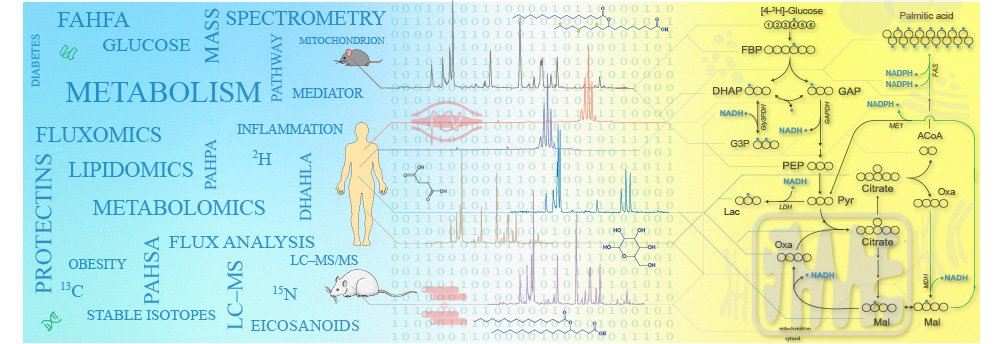
The goal of the laboratory is to elucidate how metabolites influence organ function, nutrient sensing, inter-organ communication, and liver and adipose tissue physiology. Current projects investigate complications of type 2 diabetes, adipose tissue metabolism, heart failure, various cancers, and cachexia, spanning the fields of physiology, chemistry, and bioinformatics. Core expertise includes in vivo experiments with mice (infusions, clamps, dietary experiments) and cell culture experiments (subcellular metabolomics, fluxomics). The laboratory specializes in the analysis of polar metabolites, simple and complex lipids, and lipid mediators such as FAHFAs, using advanced mass spectrometry-based methods. The workflows integrate different omics techniques, including metabolomics, lipidomics, transcriptomics and metabolic flux analysis, supported by specialized bioinformatics tools developed in the lab.



If you are interested in a Bachelor’s, Master’s, Engineer’s, or Ph.D. project in the field of biochemistry, analytical chemistry, physiology, or related disciplines, please send an email regarding available topics and their listing. The topics change dynamically.
PhD Program 2026/2027 - Call for Applications
Deciphering Lipid Metabolism in Cancer: Integrative Approaches in Metabolomics, Fluxomics, and Metabolic Engineering
This PhD project investigates the rewiring of lipid metabolic pathways in cancer using an integrative approach combining metabolomics, fluxomics, metabolic engineering, and in silico modeling. The research aims to deconvolute complex lipid metabolic pathways through metabolic flux analysis and stable isotope tracer studies, supported by Python-based data processing pipelines and advanced computational modeling.
The study incorporates experimental work, including cancer cell culture systems and in vivo mouse models, to validate findings and quantify metabolic fluxes under physiological and pathological conditions. In silico simulations of lipid metabolism will be used to predict pathway behavior and identify potential intervention points. Machine learning approaches will aid in biomarker discovery and the prediction of metabolic vulnerabilities, offering insights into the mechanisms driving cancer progression and potential therapeutic targets.
This interdisciplinary project bridges computational biology, biochemistry, and experimental cancer research, contributing to our understanding of lipid metabolism and the development of precision strategies for metabolic engineering and cancer therapy.
The work will be conducted at the IPHYS CAS. The work is financially secured in terms of material and full time position.
Candidate’s profile (requirements):
Field: Physiology / Bioinformatics
The prerequisites for success are basic knowledge of programming languages for working with data (Python), basic biochemistry (metabolites, pathways, cellular compartments), and an overview of omics disciplines. Previous experience with cell cultures and mouse experiments is an advantage.
Supervisor: Ondrej Kuda (ondrej.kuda@fgu.cas.cz)
References:
- Morigny et al. Multi-omics profiling of cachexia-target tissues reveals a spatio-temporal coordinated response to cancer. Nature Metabolism, 2026.
- Brejchova et al. Uncovering mechanisms of thiazolidinediones on osteogenesis and adipogenesis using spatial fluxomics. Metabolism. 2025 May:166:156157. doi: 10.1016/j.metabol.2025.156157
- Vondrackova et al. LORA, Lipid Over-Representation Analysis Based on Structural Information. Anal Chem. 2023 Aug 29;95(34):12600-12604. doi: 10.1021/acs.analchem.3c02039
- https://github.com/IPHYS-Bioinformatics
Biochemical Regulation of Human Milk Composition in Gestational Diabetes
This PhD project focuses on understanding how maternal metabolism and gestational diabetes mellitus (GDM) influence the biochemistry of human milk production. The student will study the physiological and metabolic mechanisms underlying lactation, with an emphasis on lipid synthesis, transport, and secretion in the mammary gland.
Experimental work will involve comprehensive analysis of human milk samples using liquid and gas chromatography coupled with mass spectrometry (LC-MS and GC-MS) to characterize lipid and metabolite composition. Metabolic tracing with non-radioactive deuterated water (2H2O) will be used to assess de novo lipogenesis and identify tissue sources contributing to milk lipids. Comparative analyses of saliva will explore its potential as a non-invasive marker of maternal metabolic status.
Through integration of biochemical data with clinical and physiological parameters, the project will reveal how metabolic control during pregnancy shapes milk composition and lactational function.
Candidate’s profile:
Field: Biochemistry + Pathobiochemistry / Physiology
The candidate should have interest in metabolism, endocrinology, and analytical biochemistry, with motivation for experimental work on human samples.
Supervisor: Ondřej Kuda (ondrej.kuda@fgu.cas.cz)
References:
- Brejchova et al. Triacylglycerols containing branched palmitic acid ester of hydroxystearic acid (PAHSA) are present in the breast milk and hydrolyzed by carboxyl ester lipase. Food Chem. 2022 Sep 15;388:132983. doi: 10.1016/j.foodchem.2022.132983.
- Brejchova et al. Distinct roles of adipose triglyceride lipase and hormone-sensitive lipase in the catabolism of triacylglycerol estolides. Proc Natl Acad Sci U S A. 2021 Jan 12;118(2):e2020999118. doi: 10.1073/pnas.2020999118
- Brezinova et al. Levels of palmitic acid ester of hydroxystearic acid (PAHSA) are reduced in the breast milk of obese mothers. Biochim Biophys Acta Mol Cell Biol Lipids. 2018 Feb;1863(2):126-131. doi: 10.1016/j.bbalip.2017.11.004
Grants
GA24-10264S METABOLIC EFFECTS OF AN ANTI-DIABETIC LIPOKINE FROM SUBCELLULAR TO INTER-ORGAN CROSSTALK
In the midst of the ongoing epidemic of type 2 diabetes, metabolomics is increasingly being used to study the activities of metabolic pathways. Stable isotope tracers are used to probe and capture the dynamic aspects of cellular metabolism. However, mammalian metabolism is a multi-component system combining the subcellular organization of pathways and inter-organ communication. We plan to identify the mechanism of an anti-diabetic lipid that presumably alters the metabolic fate of three-carbon units at different levels. In the first part, we will study the inter-organ communication and insulin-sensitizing effects of a lipokine from the family of branched fatty acid esters of hydroxy fatty acids using an obese mouse model and stable isotope tracers. The second part will investigate the mechanism using a combination of stable isotope tracers and a new class of organelle-targeted chemical probes that will allow us to selectively label and quantify subcellular metabolite pools. The results will provide a spatiotemporal picture of metabolism from the organelle to the whole body level.
LUAUS24040 New metabolic pathways of lipid trafficking
The aim of the present grant application is to perform a comprehensive quantitative analysis of intra- and inter-cellular transport of lipids, specifically fatty acids and FAHFA lipokines. 1. Transcytosis in lipid transport 2. Cyclic metabolic pathways of neutral lipids 3. Signalling through lipokines – Define the signaling potential of FAHFA through the CD36-dependent signalosome – To follow the fate of labelled fatty acids in extracellular vesicles between cell types.
NW26-01-00334 Effect of gestational diabetes on breast milk lipidome
Nutrition plays a crucial role in the early stages of life. Breast milk provides the ideal cocktail of nutrients for babies during this period of rapid development and growth, and breastfeeding has long-term health benefits. Lifestyle changes and maternal aging lead to an increased incidence of gestational diabetes mellitus (GDM). However, the effect of GDM on the lipidome and metabolome of milk is not well understood. The aim of this project is to conduct an observational study in three groups of patients: mothers with low-risk GDM treated with diet alone; mothers with GDM at increased risk with indicated drug therapy; and mothers without GDM, where we will observe the effect of GDM and metabolic control on milk composition. Parallel studies will focus on influencing colostrum composition through changes in de novo lipogenesis in the liver, adipose tissue and mammary gland. We will use liquid and gas chromatography coupled with mass spectrometry to study changes in the milk lipidome and to monitor the source of milk lipids, and metabolic labelling of de novo synthesised milk lipids using deuterated water (non-radioactive 2H2O). We will compare the changes observed in milk with the metabolomic profile of saliva. Saliva may be an alternative non-invasive source of samples, and its potential use has not yet been explored. We will use publicly available and proprietary bioinformatics tools to integrate omics and clinical data. The main scientific outcome of the EMILL project will be a unique insight into human lactogenesis and sources of milk lipids. The practical outcome will be to evaluate the impact of two antidiabetic treatment options and metabolic control on milk composition of mothers with GDM.
Projects
Achievements
Ondrej Kuda received Prize of Minister of Education 2023
Ondrej Kuda, Head of Laboratory of Metabolism of Bioactive Lipids at the Institute of Physiology of the CAS, received the Prize of the Minister of Education for outstanding results in research, experimental development and innovation on 20 November 2023. The prize was awarded for the results of research on the new signaling lipid molecules that suppress inflammation and improve glucose metabolism in patients with diabetes.

Publications
Cockayne; L. - Conroy; M. J. - Baloglu; C. - Fahy; E. - Hagn; G. - Quehenberger; O. - Armando; A. M. - Lombardi Bendoula; G. - Galano; J. M. - Sánchez-Illana; A. - Durand; T. - Kampschulte; N. - Kennedy; P. D. - Gijón; M. - Tsugawa; H. - Arita; Mak. - Maxey; K. - Truskowski; M. - Kuda; Ondřej - Khan; S. - Homer; N. Z. M. - Matsuzawa; Y. - Domingues; R. - Meikle; P. J. - Giles; C. - Huynh; K. - Murphy; R. C. - Wang; Z. - Xia; Y. - Guan; X. L. - Ekroos; K. - Liebisch; G. - Merrill Jr.; A. H. - Lopez-Clavijo; A. F. - Campopiano; D. - Wheelock; C.E. - Subramaniam; S. - Andrews; R. - Goracci; L. - Ni; Z. - Fedorova; M. - Andrews; S. - Griffiths; W. - Andrew; R. - Dennis; E. A. - O'Donnell; V. B. LIPID MAPS: Powering discovery in lipidomics. Science Signaling. 2026; 19(936); eaeg3389.
IF = 7
Morigny; P. - Ji; H. - Cussonneau; L. - Zorzato; S. - Kwon; Y. - Riols; F. - Kaltenecker; D. - Maier; A. - Karthikaisamy; V. - Corra; S. - Krauss; T. - Seeliger; C. - Gillani; S. Q. - Tissink; J. J. - Lacas-Gervais; S. - Samanci; T. F. - Maida; A. - Terron-Exposito; R. - Trinca; A. - von Toerne; Ch. - Nogara; L. - Claussnitzer; M. - Prokopchuk; O. - Bachmann; J. - Diaz; M. B. - Bindels; L. B. - Kuda; Ondřej - Hauner; H. - Haid; M. - Herzig; S. - Viscomi; C. F. - Gilleron; J. - Zeigerer; A. - Blaauw; B. - Rohm; M. Inhibition of ceramide synthesis ameliorates body wasting in a cancer cachexia model. Journal of Clinical Investigation. 2026; 136(10); e194687.
IF = 14.3
Milonaityté; Dovilé - Brejchová; Kristýna - Srp; Jaroslav - Kudová; Eva - Chodounská; Hana - Balas; L. - Durand; T. - Abumrad; N. A. - Kuda; Ondřej FAHFAs are detected in postprandial chylomicron and VLDL fractions and can be released from TG estolides by LPL in vitro. Journal of Lipid Research. 2026; 67(6); 101059.
IF = 4.9
Morigny; P. - Vondráčková; Michaela - Ji; H. - Brejchová; Kristýna - Krakovková; Monika - Makris; K. - Trubačová; Radka - Samanci; T. F. - Kaltenecker; D. - Ng; S. - Karthikaisamy; V. - Chrysostomou; S. E. - Bidovec; A. - Ponce-de-Leon; M. - Krauss; T. - Seeliger; M. - Prokopchuk; O. - Martignoni; M. E. - Claussnitzer; M. - Hauner; H. - Schweiger; M. - Bindels; L. B. - Berriel Diaz; M. - Herzig; S. - Lutter; D. - Kuda; Ondřej - Rohm; M. Multi-omics profiling of cachexia-targeted tissues reveals a spatio-temporally coordinated response to cancer. Nature Metabolism. 2026; 8(1); 237-259.
IF = 27.5
Riečan; Martin - Kasperová; B. J. - Vondráčková; Michaela - Janovská; Petra - Haasová; Eliška - Adamcová; Kateřina - Ivák; P. - Hlaváček; D. - Kroupová; K. - Čajka; Tomáš - Kopecký; Jan - Štemberková-Hubáčková; S. - Mráz; M. - Netuka; I. - Melenovský; V. - Haluzík; M. - Kuda; Ondřej Epicardial adipose tissue produces L-3-hydroxybutyrate in advanced heart failure: direct analysis of fat metabolic remodeling. Metabolism-Clinical and Experimental. 2026; 175(Feb); 156465.
IF = 16.7
Photogallery




People
Head of Laboratory

Deputy Head of Laboratory
Laboratory staff