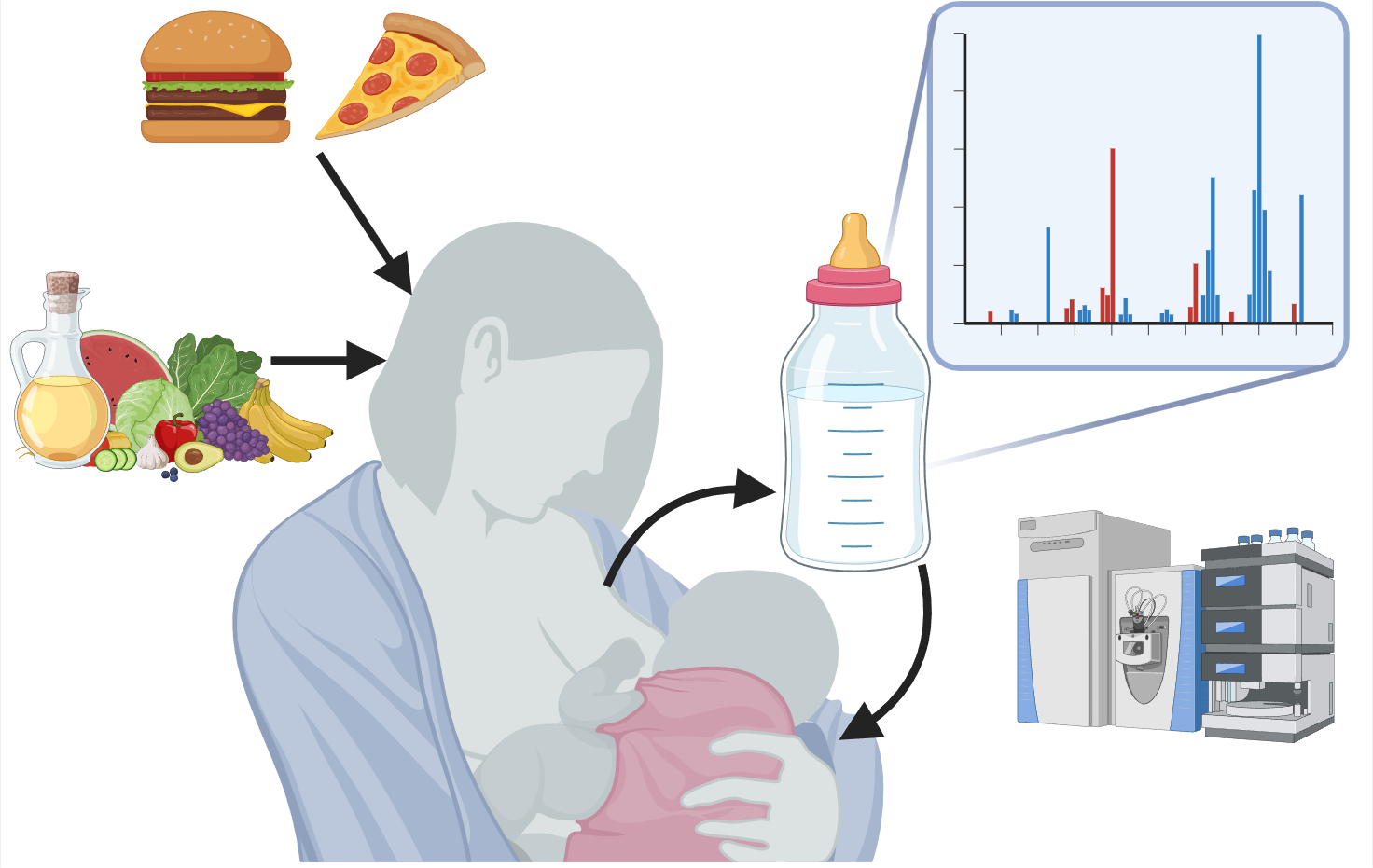
A mother’s diet and body weight leave “metabolic fingerprints” in her milk and in her child’s metabolism that may increase the risk of obesity. However, part of the damage can be mitigated through healthier eating during breastfeeding. Two new studies from researchers of the University of the Balearic Islands (UIB) and the Laboratory of Adipose Tissue Biology of IPHYS show that a baby’s metabolic fate is influenced as early as during pregnancy and lactation. Mother’s milk plays a key role as a carrier of hidden metabolic signals.
IPHYS has been studying for a long time the lasting impact of various prenatal and early postnatal factors on health and development throughout life. The latest results confirm that pregnancy and infancy are decisive periods in determining how the body will handle nutrients and energy, and how prone it might be to obesity or metabolic diseases. What mothers eat matters much more than we might expect. Professor Catalina Picó from UIB has long been studying this topic in collaboration with the team of Dr. Jan Kopecký at IPHYS CAS.
In their latest study, the scientists analyzed the composition of breast milk during the first month of lactation in 52 mother–infant pairs using advanced metabolomic and lipidomic analyses conducted at the Department of Metabolomics of IPHYS, led by Assoc. Prof. Tomáš Čajka. “We found that maternal overweight or obesity was linked to higher lactose levels and lower levels of several bioactive compounds in milk. Specifically, a lower concentration of orotic acid—a molecule involved in balanced cellular energy supply—was associated with faster weight gain in infants during the first month of life,” explains Dr. Petr Zouhar, one of the study’s Czech co-authors.
Detailed analyses also revealed that milk from mothers who more strictly followed a Mediterranean-style diet rich in fruits and fish showed a more favorable metabolite profile. This was associated with steadier infant growth, without excessive or insufficient weight gain.
The Role of Maternal Diet and Breast Milk
It remains to be proven whether these differences in infant growth are truly caused by the presence of specific compounds in breast milk—something extremely difficult to test directly in humans. Animal models, however, can shed light on such mechanisms. In a complementary study by the same research teams, the scientists used laboratory rats to separate the effects of maternal diet during pregnancy and lactation on the metabolic profile of their offspring in adulthood.
Rat mothers were fed either a nutritionally balanced standard diet or a “Western-style” diet high in fat and sugar throughout both gestation and lactation. Another group consumed the unhealthy diet only during pregnancy but switched to a balanced diet while nursing. Earlier results already showed that offspring of mothers exposed to the unhealthy diet had a somewhat higher risk of developing obesity in adulthood. A more detailed analysis of these rats’ blood samples now revealed that many changes in plasma metabolite levels disappeared when the mothers switched to a healthier diet during lactation.
One important component of milk is the hormone leptin. In adult animals, leptin directly regulates food intake, but in newborns, it contributes to the developmental “programming” of future metabolism. In part of the study, researchers supplemented suckling pups with additional leptin doses to mimic higher leptin intake through milk. This treatment favorably influenced the plasma metabolite profile of adult offspring.
Both studies underscore pregnancy and breastfeeding as critical “windows” when lifelong susceptibility to obesity and metabolic disease is established. “Our results have major implications for preventing childhood obesity. The first months of life represent a sensitive period when nutrition programs long-term metabolic health and obesity risk. Breast milk is not a ‘static’ fluid—it dynamically reflects the mother’s metabolic state and diet, ranging from obesity to diet quality,” adds Jan Kopecký, head of the Czech research team.
References:
- Pomar C. A., Martin-Chamorro R. A., Zouhar P., Castillo P., Cajka T., Kopecky J., Palou A., Palou M., and Pico C. Metabolomic Insights Into the Impact of a Maternal Western-Style Diet and Leptin Supplementation During Suckling on Adult Rat Offspring. FASEB J 40, e71452 (2026). DOI:10.1096/fj.202501729RRR
- Pomar C. A., Zouhar P., DeLucas M., Cajka T., Cobo P., Jiménez-Cabanillas M. V., Bibiloni P., Kopecky J., Palou A., Serra F., Sánchez J., and Picó C. Breast Milk Metabolomic Profile Is Associated With Maternal Overweight/Obesity Status or Adherence to Mediterranean Diet and Infant Weight Gain During the First Month of Lactation. Food Frontiers 6, 1454-1468 (2025). DOI:10.1002/fft2.70017