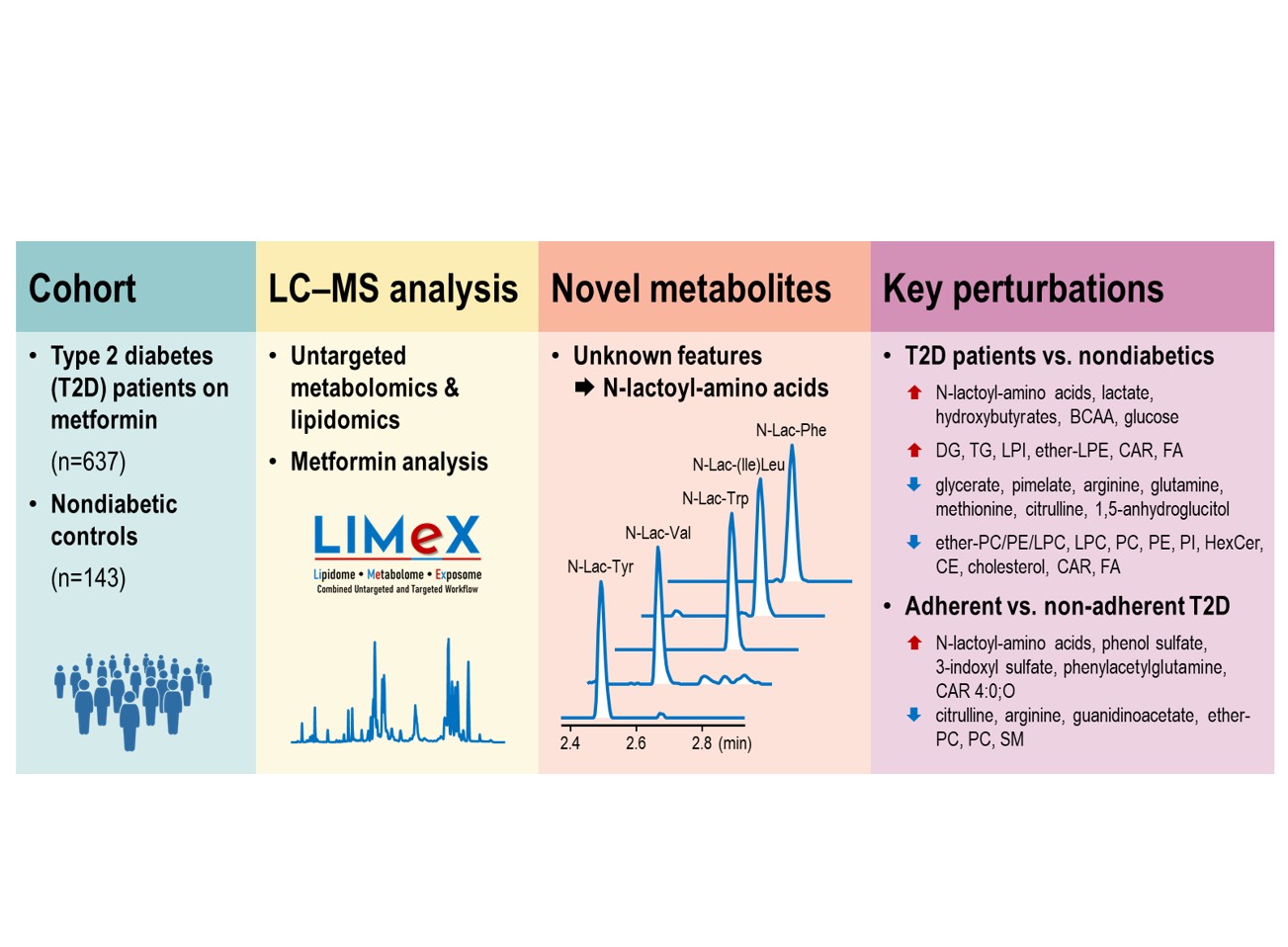
Metformin is currently the first-line oral drug of choice for the treatment of type 2 diabetes. It reduces glucose production in the liver, improves tissue sensitivity to insulin, and does not cause weight gain or hypoglycemia, which sets it apart from some other antidiabetic drugs. Moreover, its long-term beneficial effects on the risk of cardiovascular complications and mortality in people with type 2 diabetes have been well established. Researchers from the Institute of Physiology CAS (IPHYS) have identified a new group of blood metabolites that could help physicians objectively monitor whether patients with type 2 diabetes are taking their metformin as prescribed.
New biomarkers for metformin use
A team led by Tomáš Čajka from the Laboratory of Translational Metabolism at IPHYS analyzed plasma samples from 637 patients with type 2 diabetes treated with metformin and 143 non-diabetic controls using advanced metabolomics and lipidomics. Among 614 detected metabolites, they identified five from the group of N-lactoyl-amino acids (e.g. N‑lactoyl-phenylalanine), which had previously been seen as unknown signals due to missing reference spectra in databases. The levels of these metabolites in the blood closely reflected the plasma concentrations of metformin. In patients with the highest metformin exposure, the concentrations of these metabolites were up to 7.2 times higher than in controls.
A sensitive “fingerprint” of the drug’s effect
N-Lactoyl-amino acids are formed in cells by combining lactate and amino acids, thus reflecting the metformin-induced changes in cellular energy metabolism. “Importantly, even though they occur in plasma only at nanomolar concentrations, they reliably distinguish patients who take metformin regularly from those who take it irregularly or not at all,” emphasizes T. Čajka.
Metabolomics in practice and international collaboration
The study also provides a detailed description of broader metabolic changes in type 2 diabetes, including increases in lactate, organic acids, and branched-chain amino acids, as well as extensive remodelling of the lipid profile. In addition to T. Čajka’s team, collaborators from the Institute for Clinical and Experimental Medicine in Prague and the West Coast Metabolomics Center (University of California, Davis) also participated in the study.
The results demonstrate that advanced metabolomics approaches developed at IPHYS within the CarDia project can find highly practical applications both in clinical studies and in personalized monitoring of treatment in patients with diabetes.
Reference: Cajka T., Hricko J., Rudl Kulhava L., Paucova M., Novakova M., Hola V., Rakusanova S., Fiehn O., Skop V., Lankova I., Miskova I., Pelikanova T., and Haluzik M.: Untargeted Metabolomics Identifies N-Lactoyl-Amino Acids as Dose-Responsive Plasma Biomarkers of Metformin Adherence in Type 2 Diabetes. Clinical Pharmacology & Therapeutics (2026). IF = 5.5; DOI: 10.1002/cpt.70205