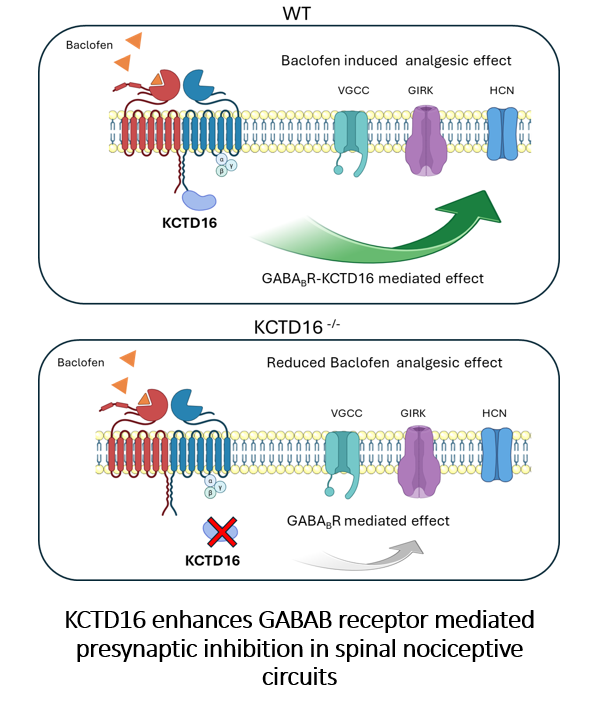
Pain originates and is maintained within complex neural circuits, where the balance between excitatory and inhibitory signals in the dorsal horn of the spinal cord is crucial. Disruption of this balance can lead to heightened sensitivity and persistent (chronic) pain. The team of Jiří Paleček, head of the Laboratory of Pain Research at IPHYS, in collaboration with the Institute of Experimental Medicine CAS, has identified a new “pain dampener” — the auxiliary protein KCTD16, whose presence modulates the activity of one of the key inhibitory receptors, GABAB. The GABAB–KCTD16 complex thus represents a promising molecular target for the development of gentler analgesics in the future.
Chronic pain affects roughly one in ten people worldwide, and current treatments often suffer from limited efficacy and pronounced side effects. There is therefore an urgent need for new, more targeted therapeutic strategies. The neurotransmitter GABA plays a fundamental role in suppressing signals within neural circuits that convey pain perception (so-called nociceptive pathways). It acts through fast-acting GABAA and slower, modulatory GABAB receptors. As a major inhibitory receptor, GABAB regulates how easily individual neurons and their networks become activated. Dysfunction of this receptor has been implicated in the development and progression of chronic pain, epilepsy, addiction, and certain psychiatric disorders. The auxiliary KCTD proteins (KCTD8/12/16) bind to GABAB receptors and significantly modulate their function.
In this new study, the researchers used a range of experimental approaches to describe in detail, for the first time, the localization of the regulatory protein KCTD16 within nociceptive pathways and, most importantly, how it influences the initiation and modulation of pain. “We showed that KCTD16 is a critical factor in pain transmission and demonstrated how it affects the balance between excitation and inhibition in nociceptive circuits,” explains Jiří Paleček, the corresponding author of the study. From a practical perspective, the GABAB–KCTD16 receptor complex represents a novel and highly specific molecular target for the potential development of a new generation of neuromodulatory therapies with greater efficacy and fewer systemic side effects.
Reference: Vasconcelos D., Heles M., Adamek P., Bhattacharyya A., Melichar A., Turecek R., Palecek J.: The role of auxiliary GABAB receptor subunit KCTD16 in pain modulation. Neurobiology of Disease 220:107286 (2026). IF = 5. 6 DOI: 10.1016/j.nbd.2026.107286