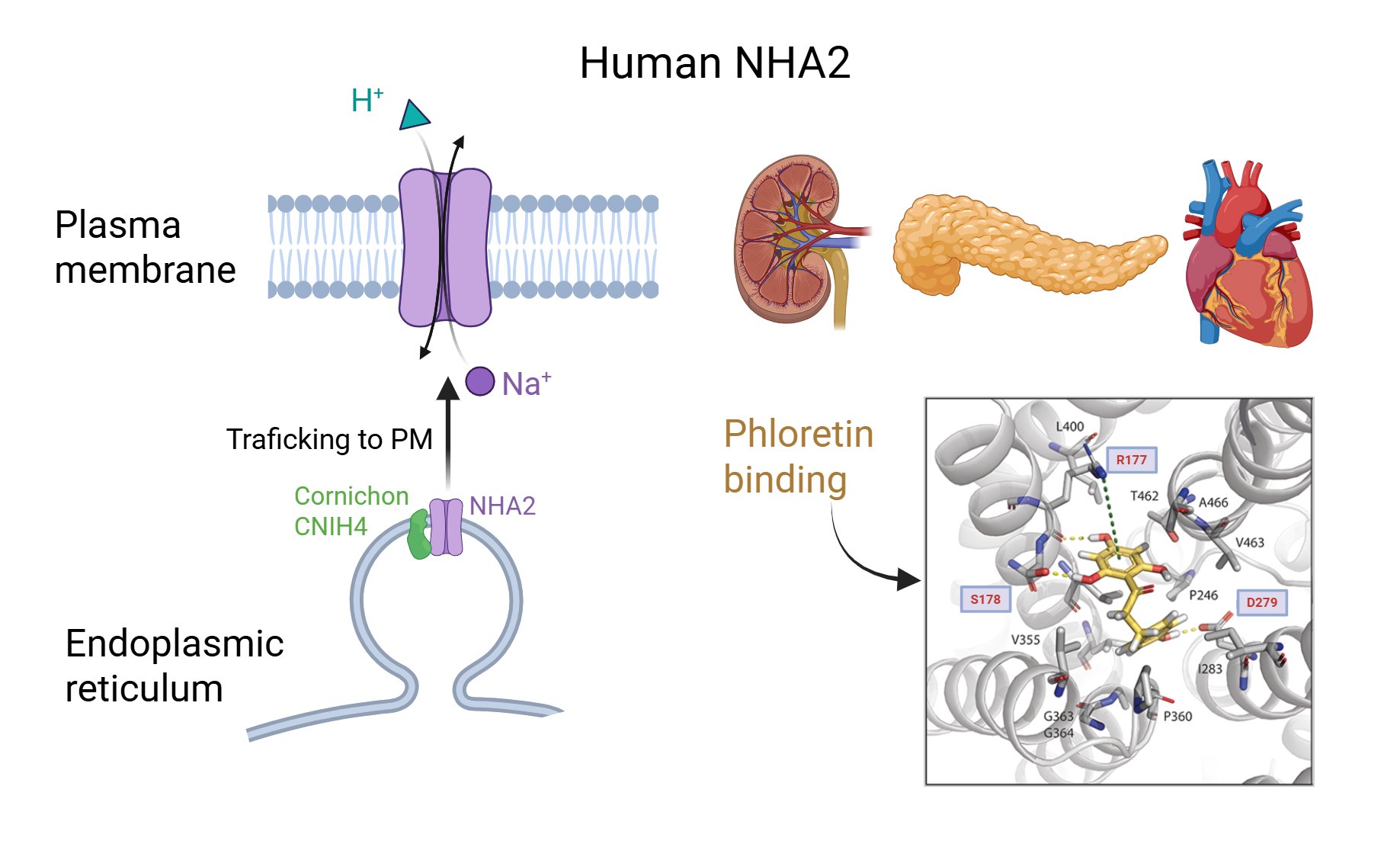
The human protein NHA2, which exchanges sodium and lithium ions for protons, helps maintain cellular pH, ion homeostasis, and cell volume. Proper NHA2 function is essential for blood pressure regulation, insulin secretion, and the activity of organs such as the kidney and pancreas. The team led by Olga Zimmermannová of IPHYS has newly described how NHA2 is delivered to the correct cellular location in the plasma membrane and how its function can be specifically inhibited by the small molecule phloretin. Together, these findings open the way to developing new drugs targeting metabolic and cardiovascular disorders.
A study using the yeast Saccharomyces cerevisiae as a model organism showed that small proteins of the cornichon family (CNIH/Erv14), acting as cargo receptors of COPII vesicles , are required for transport of NHA2 from the endoplasmic reticulum to the plasma membrane. Bioinformatic analysis of nearly two thousand cornichon protein sequences identified key binding regions, and subsequent experiments revealed that cornichons CNIH1, CNIH2 and especially CNIH4 ensure proper targeting and activity of human NHA2. In a related study, the team demonstrated how phloretin, a flavonoid abundant in apples, specifically inhibits NHA2 activity. By combining molecular modelling with site‑directed mutagenesis, they identified the amino acid residues that form the binding site on NHA2 for this inhibitor.
The results provide a comprehensive view of NHA2 biogenesis and regulation, from its trafficking along the secretory pathway to its detailed interaction with an inhibitor. Because NHA2 modulates processes linked to hypertension, diabetes, and metabolic syndrome, it is emerging as a promising target for pharmacological intervention. Moreover, the interaction of NHA2 with cornichon proteins suggests that its activity can be modulated indirectly, by altering its cellular trafficking rather than solely by direct inhibition of its transport site.
References:
- Kacovska K., Papouskova K., Masrati G., Rosas-Santiago P., Przeczkova T., Zarska V., Ben-Tal N., and Zimmermannova O. Trafficking of the human Na+/H+ antiporter NHA2 to the plasma membrane requires cornichon COPII cargo receptors. Protein Sci 35: e70492 (2026). IF = 5.2; DOI:10.1002/pro.70492
- Zimmermannova O., Kubes M., Przeczkova T., and Masrati G. Residues R177 and S178 of the human Na+/H+ antiporter NHA2 are involved in its inhibition by the flavonoid phloretin. FEBS Lett 599: 901-911 (2025). IF = 4.2; DOI:10.1002/1873-3468.15089