The Hidden Power of Two Key Brain Receptors
Muscarinic and opioid receptors are among the most important proteins in the brain that transmit chemical signals into cells. Muscarinic receptors regulate memory, attention, mood, and various everyday functions, including digestion and heart rate. When they malfunction, diseases such as Alzheimer’s disease, depression, or schizophrenia may develop. Opioid receptors are equally important—they control pain perception, mood, and sleep, making them crucial targets for treating chronic pain and mood disorders. However, current drugs that activate these receptors often cause unpleasant side effects such as excessive sweating, constipation, or respiratory depression, which limit their clinical use.
A Surprising Discovery: A Shared Cholesterol-Binding Site
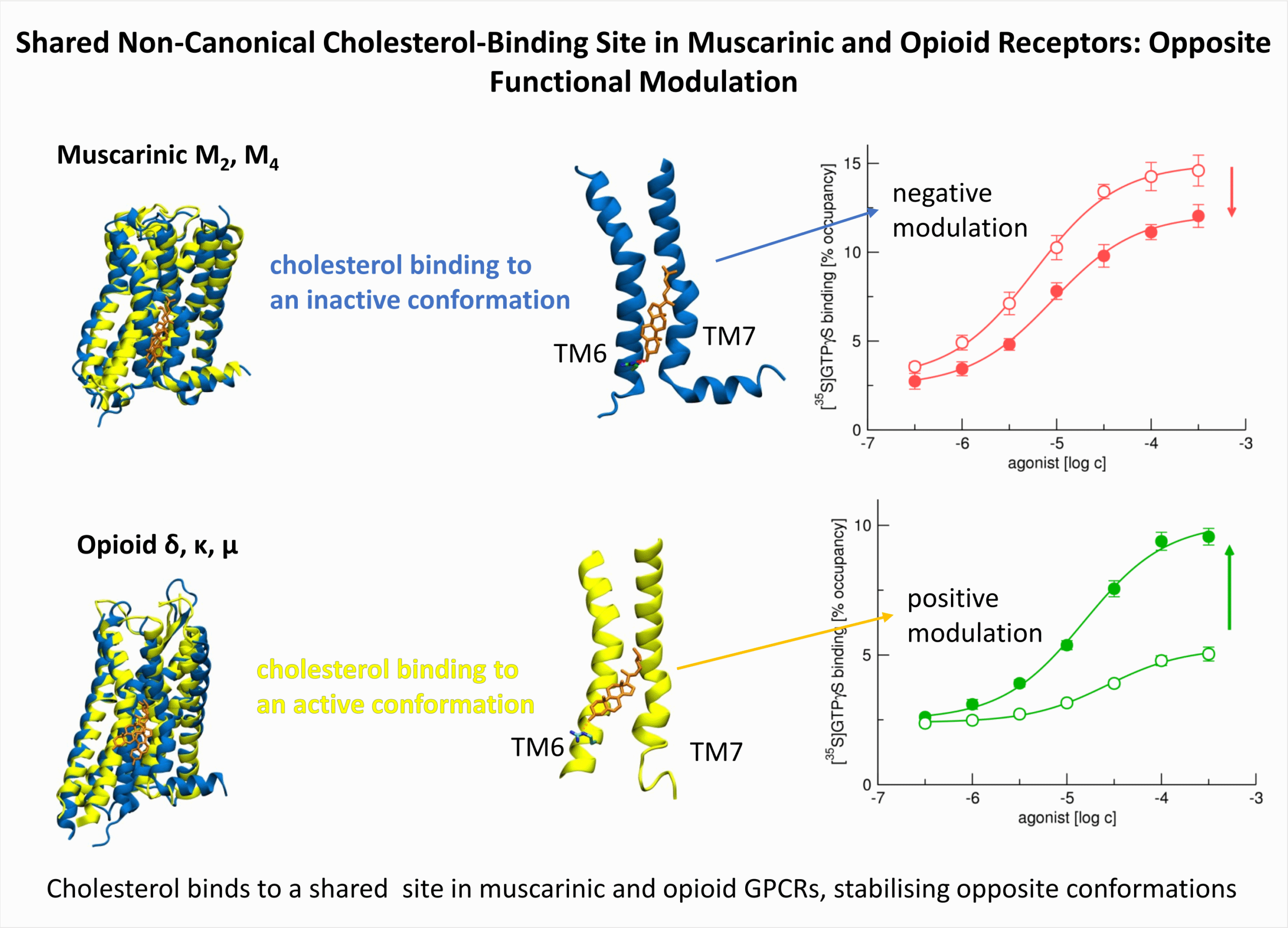
Scientists from the Laboratory of Neurochemistry at IPHYS have made a remarkable discovery: both muscarinic and opioid receptors share an unexpected feature—a cholesterol-binding site that functions in a completely new way. Using advanced molecular dynamics simulations, the team identified a non-canonical cholesterol-binding site located at a critical point in receptor architecture—specifically on the sixth transmembrane helix, involving a key amino acid known as arginine 6.35.
Unlike previously known cholesterol-binding patterns, this newly identified site works through a fundamentally different mechanism. It does not follow the well-known “CRAC” or “CCM” binding motifs that scientists have studied for years. Instead, cholesterol fits into a narrow groove between the sixth and seventh transmembrane helices, where it directly interacts with the receptor through hydrophobic interactions and hydrogen bonding.
How This Changes Drug Development
This discovery opens entirely new avenue for developing “smarter” medications. The research showed that when cholesterol binds to this site, it differentially modulates these two receptor types: it dampens the activity of muscarinic receptors while enhancing the activity of opioid receptors. In other words, cholesterol acts as a natural “brake” on muscarinic receptors but as an “accelerator” for opioid receptors.
The greatest promise lies in tissue-specific drug targeting. Since different tissues contain varying amounts of cholesterol, drugs designed to target this cholesterol-binding site could theoretically be more selective—working effectively in some tissues while “avoiding” others. For instance, neural tissues (the brain and spinal cord) are particularly rich in cholesterol, whereas smooth muscle cells contain much less cholesterol. By designing sterol-based therapeutic molecules, scientists could create medications that preferentially affect the brain while sparing peripheral tissues, potentially minimising the unwanted side effects that plague current treatments.
This approach reflects a growing interest in positive allosteric modulators (PAMs)—drugs that enhance natural signalling without directly activating receptors— offering a path toward safer, more selective pain management and cognitive disorder treatments.
Reference: Chetverikov N., Janoušková – Randáková A., Nelic D., Jakubík J.: Cholesterol differentially modulates the activity of opioid and muscarinic receptors via a common binding site. Biochemical Pharmacology 242:117296 (2025). IF = 5.6. DOI: 10.1016/j.bcp.2025.117296