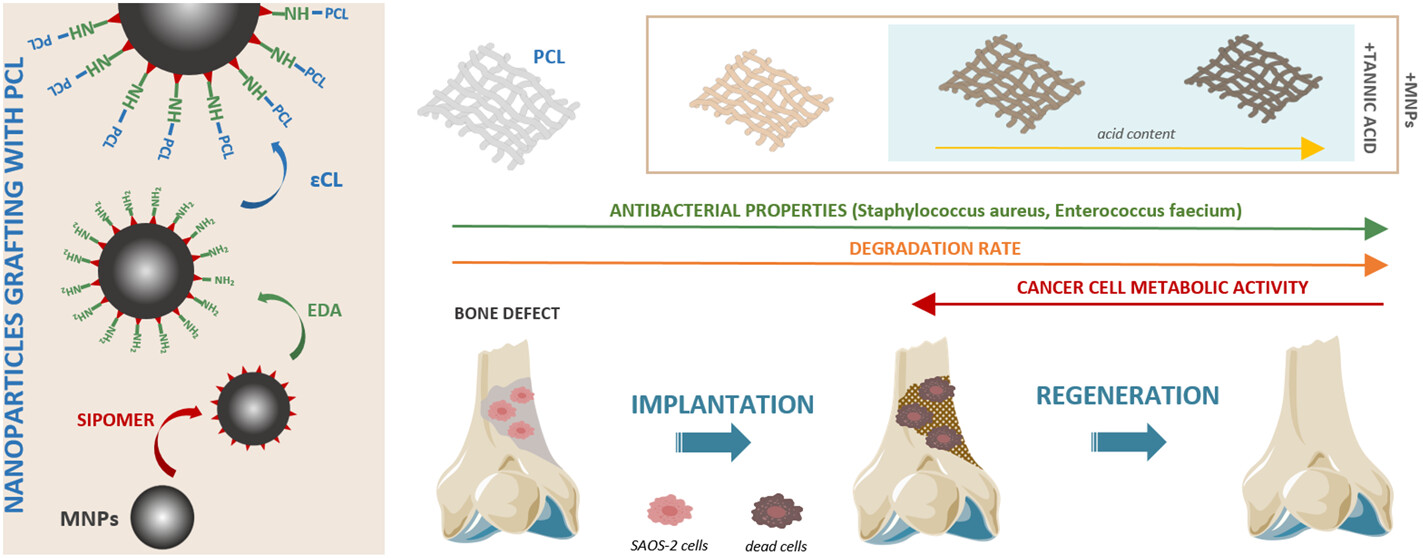
An international team led by Małgorzata Świętek from the Institute of Macromolecular Chemistry of the Czech Academy of Sciences has developed nanofibrous membranes using the electrospinning of poly(ε-caprolactone) (PCL) combined with magnetic nanoparticles (MNP) and natural polyphenol – tannic acid. The material is intended to fill bone defects following tumor removal surgery, where it is also expected to promote bone regeneration and reduce the risk of osteosarcoma recurrence. Antonín Brož, Marina Malić and Lucie Bačáková, from the Laboratory of Biomaterials and Tissue Engineering at IPHYS, also made significant contributions to the research by evaluating the response of osteosarcoma cells to the newly developed material.
How it works: magnetic particles and tannic acid
PCL is a well-known biocompatible and biodegradable polymer. However, when combined with MNPs and tannic acid, it becomes a unique composite with a biocompatible matrix and bioactive components. The nanofiber nature of the material allows nutrients and oxygen to pass through. This is important for successfully colonizing the material with living cells that can then form new tissue. The presence of MNPs affects the material’s physical and biological properties, including its antibacterial effect. MNPs can multiply the effects of an external magnetic field on cells inside the material. Tannic acid is a purely bioactive element of the composite. It is released mainly during the first hours after contact with a biological environment and exhibits antioxidant, anti-inflammatory, and anti-tumor properties. The ratio of magnetic particles to tannic acid can be adjusted to regulate the rate of material degradation and the intensity of its biological effects.
Effects on tumor cells and bone healing
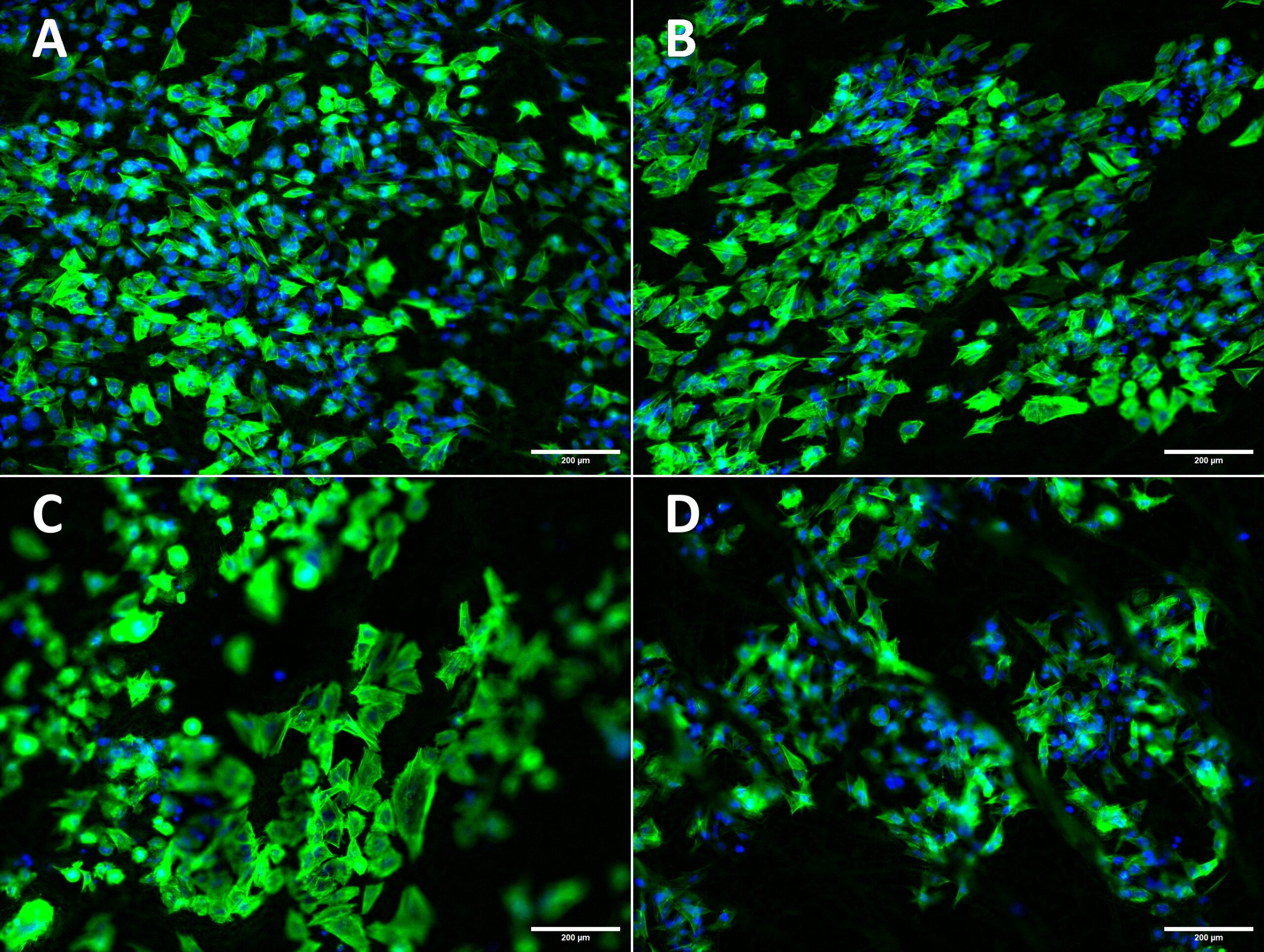
In experiments using the human osteosarcoma cell line SAOS-2, researchers found that the presence of tannic acid reduces both the metabolic activity and the number of tumor cells. This effect increases with higher concentrations of tannic acid. At the same time, they demonstrated that, within a certain concentration range, tannic acid promotes osteogenic cell activity. Thus, the material has the potential to suppress tumors and promote bone tissue regeneration. However, the authors point out that precise dosing of tannic acid is crucial, as it acts as a so-called “double-edged sword.” In the presence of MNP, tannic acid may promote the formation of reactive oxygen species instead of eliminating them, and long-term elevated production of these species can negatively affect even healthy cells.
Protection against infection and further research steps
The composites with the highest tannic acid content (10%) significantly suppressed the growth of Enterococcus faecium and Staphylococcus aureus, bacteria often found in orthopedic procedure-related infections, reducing their number by over 90% compared to pure PCL. However, the situation was more complex for other bacterial strains, such as Klebsiella pneumoniae and Escherichia coli. Some of these bacteria were able to partially utilize tannic acid as a source of energy; therefore, further optimization will be necessary. The authors plan to examine how these magnetic scaffolds behave in the presence of an external magnetic field. This will help them verify the potential for targeted therapy and monitor bone healing in living organisms using imaging techniques.
Reference: Hlukhaniuk A., Świętek M., Patsula V., Janoušková O., Brož A., Malić M., Kołodziej A., Wesełucha-Birczyńska A., Hodan J., Slouf M., Tokarz W., Zasońska B., Bystrianský L., Gryndler M., Bačáková L., Horák D.: Electrospun PCL mats modified with magnetic nanoparticles and tannic acid with antibacterial and possible antiosteosarcoma activity for bone tissue engineering and cancer treatment. ACS Biomater Sci Eng 11(7):4315-4330 (2025). doi: 10.1021/acsbiomaterials.5c00116. IF = 5.5.
Microscopic figure legend: Decreasing number of SAOS-2 osteosarcoma cells depending on tannic acid concentration in polycaprolactone nanofibrous membranes. Tannic acid content: A – 0 wt%, B – 1 wt%, C – 5 wt%, D – 10 wt%. Actin cytoskeleton in cells is stained green, cell nuclei blue. Scale bar: 200 µm.