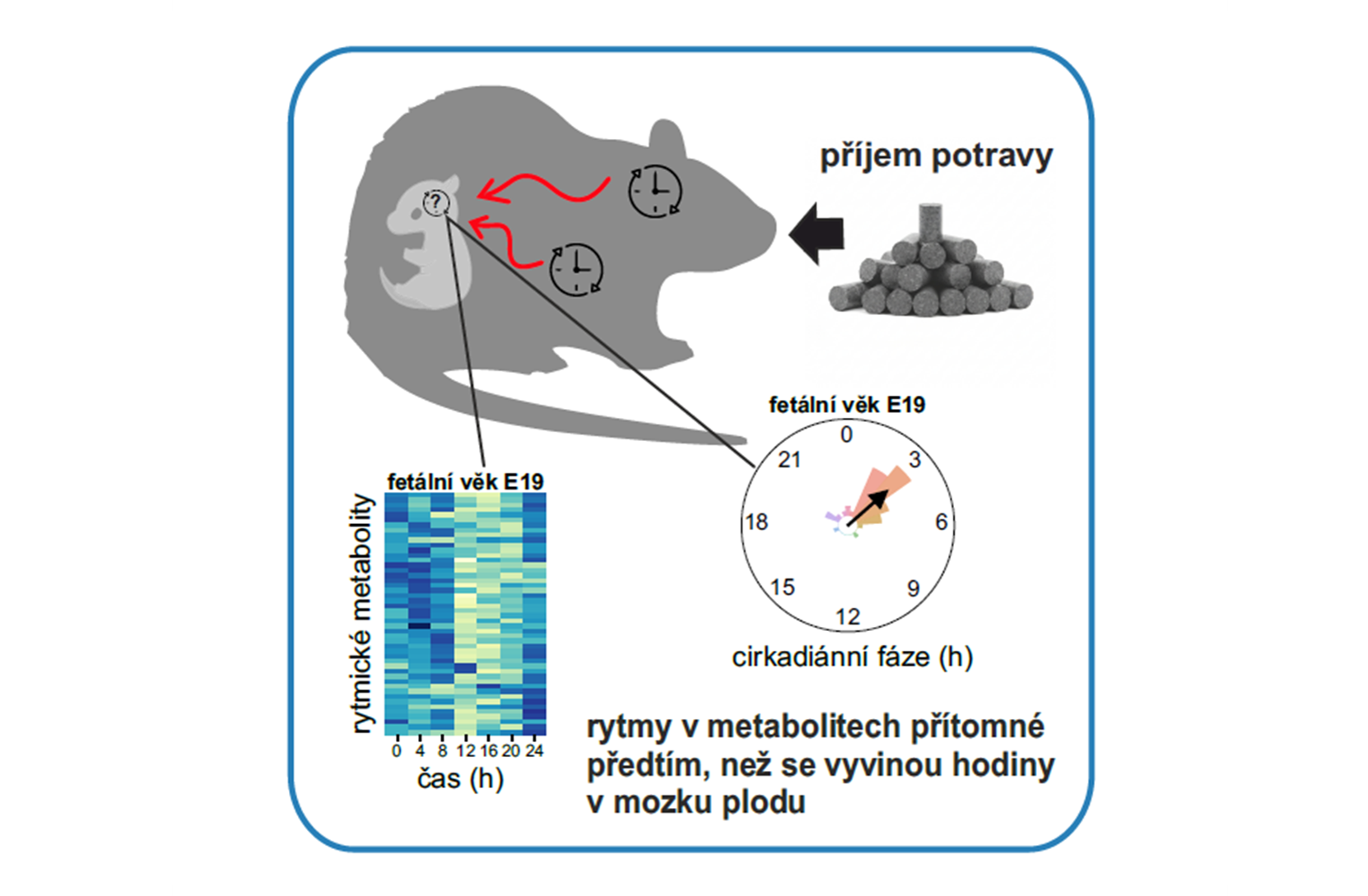
Mother communicates with the developing fetal brain through rhythmic metabolic signals even before the fetus’s own biological clock is fully developed, as shown by the team of Alena Sumová from the Institute of Physiology of the Czech Academy of Sciences. A new study, published in the prestigious journal PLOS Biology, brings breakthrough insights into the development of circadian rhythms in mammals and reveals previously unknown metabolic signals that the mother passes to the fetus through nutrition.
The research team analyzed the development of molecular circadian clocks in rats from the prenatal period through to adulthood. “Our results show that, even before the fetus’s own circadian clocks start operating, rhythmic metabolic signals originating from the mother’s diet are already present in its brain,” explains the study’s lead author Alena Sumová, head of the Laboratory of Biological Rhythms at IPHYS. “We identified rhythms in levels of essential amino acids, carnitines and nucleosides in the fetal brain, which disappear after birth and reappear only after weaning.”
The study demonstrated that circadian clocks in rat fetuses develop gradually. On embryonic day 19, i.e., 2–3 days before birth, they are not yet fully functional. Nevertheless, metabolism in the fetal brain already shows 24‑hour rhythms, suggesting that these rhythms are driven by signals from the mother’s body rather than by the fetus’s own clocks.
Aplication COMA: Circadian Ontogenetic Metabolomics Atlas
A major contribution of the project was the use of the freely available new web application COMA, developed in 2025 at IPHYS with support from the National Institute for Research of Metabolic and Cardiovascular Diseases (CarDia). COMA is an interactive, open database that maps circadian (daily) metabolic rhythms in sixteen rat anatomical structures across different developmental stages and contains a complete dataset of metabolomic and lipidomic profiles from various tissues throughout development for the wider scientific community.
“COMA represents a unique research tool that allows scientists worldwide to browse our data, generate their own graphs and discover new links between circadian rhythms and metabolism,” adds study co‑author Tomáš Čajka, who developed the application together with Alena Sumová. The application is the result of a long‑term effort toward open science and ensures that the data will serve other researchers in the fields of chronobiology and metabolomics.
The research was financially supported by the Czech Science Foundation and, crucially, also by the National Institute for Research of Metabolic and Cardiovascular Diseases (CarDia) within the EXCELES programme funded by the European Union through the Next Generation EU initiative. “The EXCELES programme has enabled us to use state‑of‑the‑art metabolomics infrastructure and to link research on the basic mechanisms of biological clocks with applied research on metabolic diseases,” says Martin Sládek, the study’s first author. “Linking circadian rhythms with metabolism is crucial for understanding the development of lifestyle diseases, including obesity, diabetes and cardiovascular disorders.”
The study’s findings have far‑reaching implications for perinatal medicine. Disruption of the mother’s circadian rhythms – for example due to shift work or an unhealthy lifestyle during pregnancy – could affect the setting of the offspring’s biological clocks and increase the risk of metabolic disorders later in life. “Our findings open new possibilities for preventing metabolic and cardiovascular diseases already in the prenatal period,” concludes Alena Sumová. “Understanding how the mother synchronizes the fetal biological clocks could lead to recommendations for pregnant women regarding regular meal timing and daily routines.”
Reference: Sládek M., Houdek P., Čajka T., Sumová A.: Maternal food-derived signals oscillate in the fetal suprachiasmatic nucleus before its circadian clock develops. PLoS Biol 23(9): e3003404 (2025). DOI: 10.1371/journal.pbio.3003404