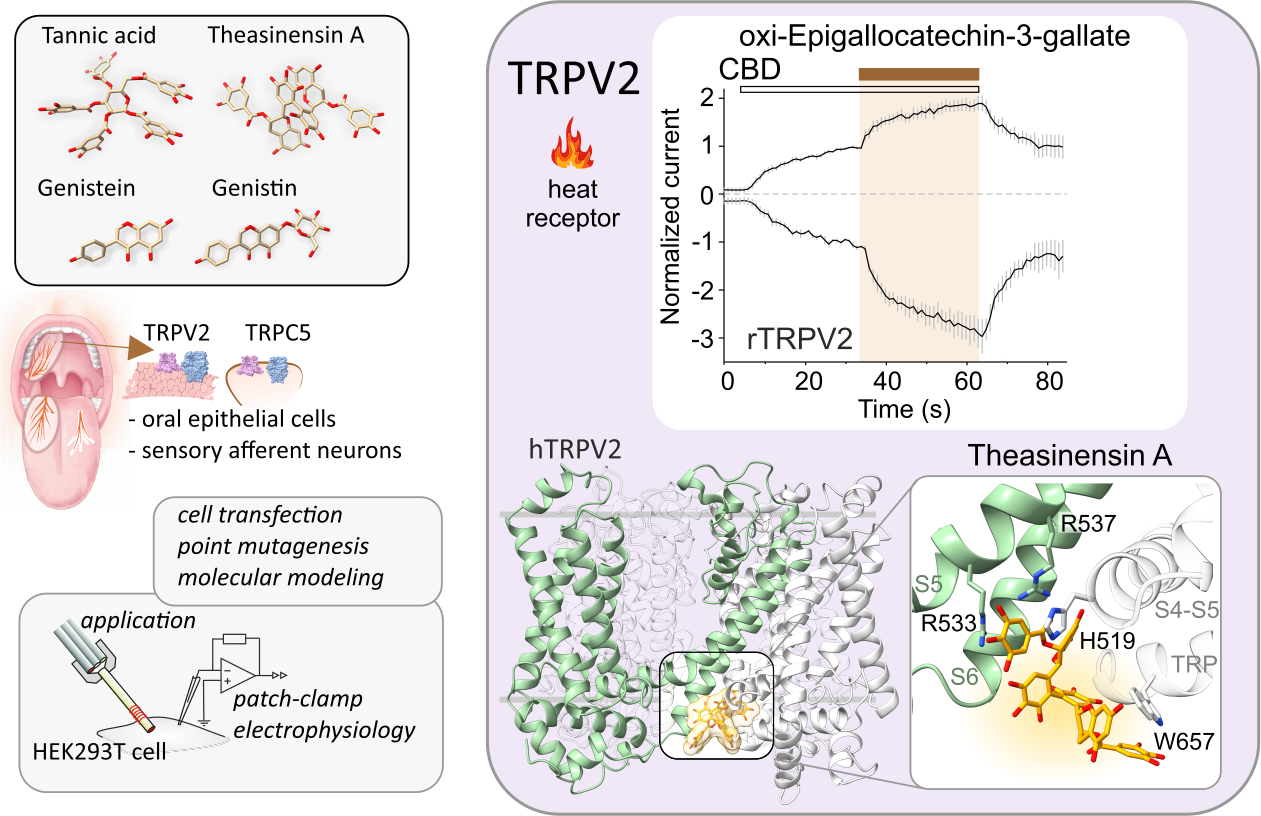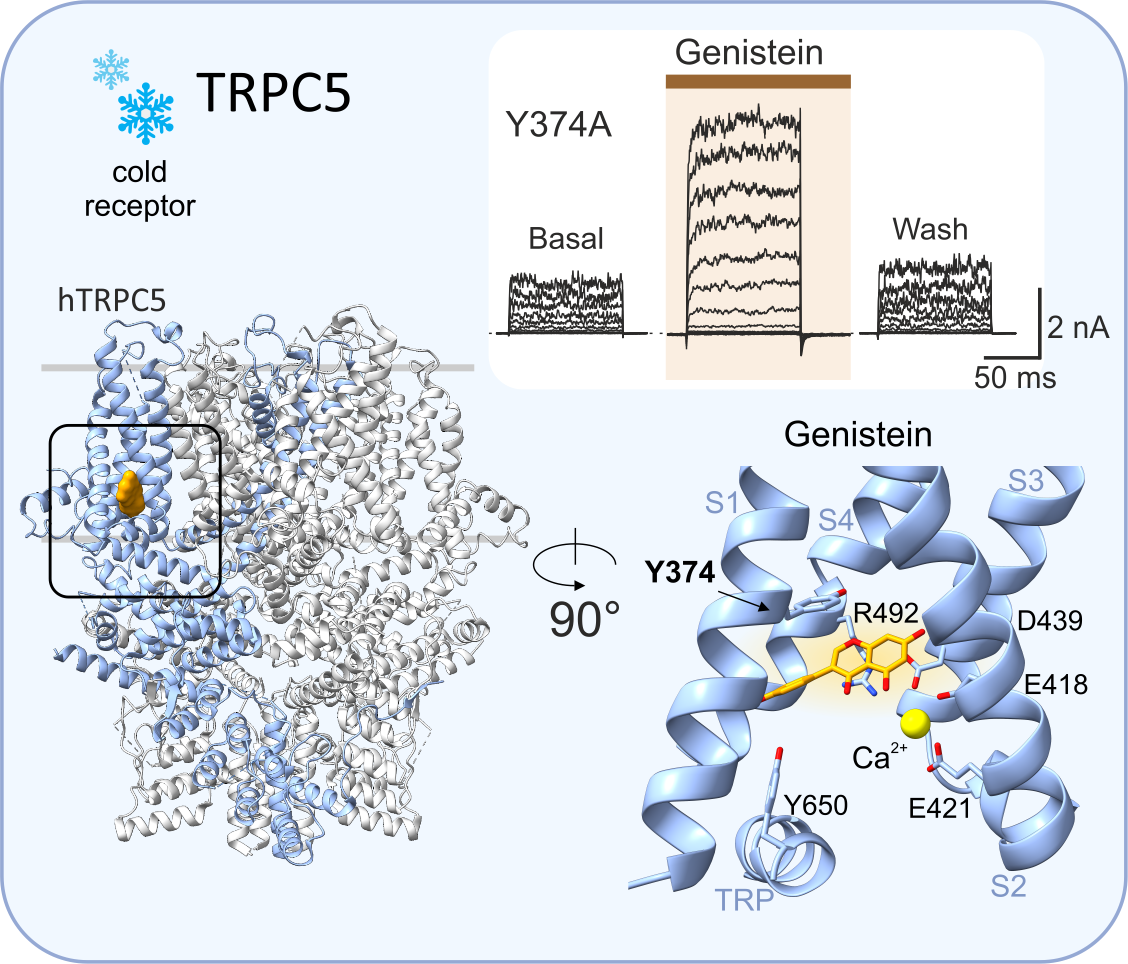
The team of Viktorie Vlachová from the Laboratory of Cellular Neurophysiology of IPHYS has provided a detailed description of two ion channels, TRPV2 and TRPC5, as previously unknown “sensors” for certain astringent (drying) compounds found in tea, wine, and soy. TRPV2 and TRPC5 are not only involved in taste perception – they are also present in epithelial, immune, and cancer cells, where they influence inflammation, barrier function, and cell survival. Discovering new ways to regulate the activity of these channels using compounds with antioxidant, anti-inflammatory, and anticancer effects opens new avenues for research and the use of natural substances as subtle “modulators” of sensory neurons, oral pain, and tumour growth.
Astringency is a complex sensation of dryness and roughness in the mouth that arises not only from friction of the mucosal surface but also from activation of specialized receptors in nerve endings and epithelial cells. Typical astringent sensations are caused by plant polyphenols such as catechins from green tea, tannins, or isoflavones (genistein) from soy. These compounds alter the properties of saliva and the mucosal surface but can also directly affect ion channels in oral sensory nerves. Astringency acts similarly to pungency: it serves as a warning signal to limit consumption of potentially problematic foods.
The TRPV2 and TRPC5 proteins are non-selective cation channels which, when activated, allow sodium and calcium ions—and occasionally other small cations—to enter the cell. This alters the membrane’s electrical charge and triggers signalling processes in neurons as well as in muscle, immune, or tumour cells. Surprisingly, the authors found that the astringent substances discussed above modulate TRPV2 and TRPC5 channel activity differently in rats and humans. These differences indicate that the same natural compounds can have opposite effects on the same channels across different species, likely reflecting evolutionary adaptations in diet and receptor function. On the other hand, the study also confirmed that human TRPV2 can be activated by high temperatures above 55–60 °C, similar to the rat channel.
Using computer modelling and electrophysiological measurements, the researchers further showed that both channels can directly interact with the membrane protein mucin (MUC1), a component of the protective mucus layer on the oral mucosal surface. The presence of MUC1 alters the basal activity of TRPC5 as well as the response of TRPV2 to genistein, suggesting that disruption of the protective layer and receptor activation are functionally interconnected processes.
Reference: Kadkova A., Kosinova K., Klouckova M., Strachotova D., Barvik B., Zimova L., Vlachova V.: TRPV2 and TRPC5 are potential targets for astringent phytochemicals. Current Research in Food Science 12:101306 (2026). DOI: 10.1016/j.crfs.2026.101306 IF = 7.0