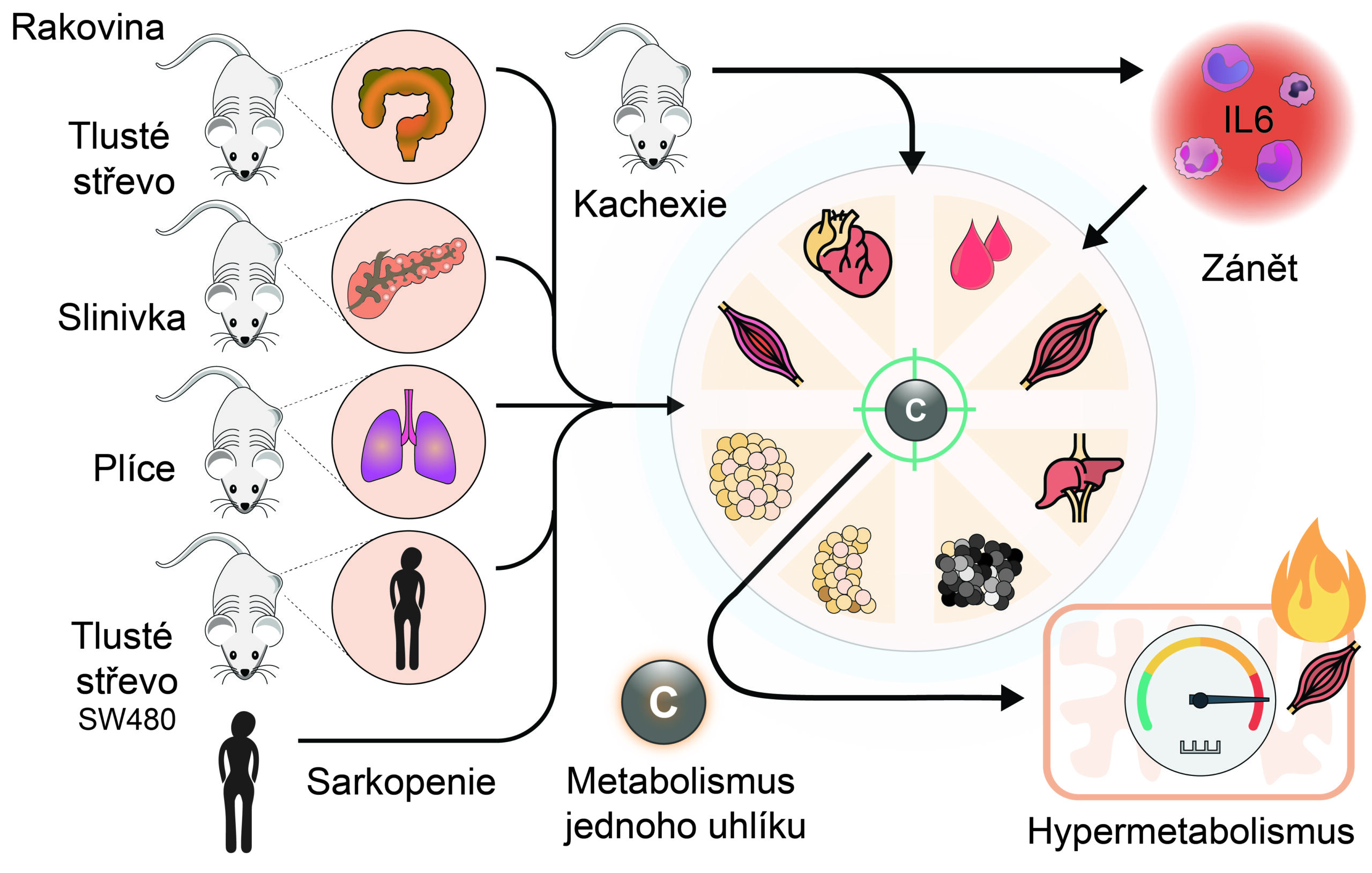
Cachexia causes uncontrolled weight loss and muscle wasting in chronic diseases and cancer. A new study, conducted in collaboration between IPHYS and the Helmholtz Munich research centre, provides the first evidence for new therapeutic strategies. The researchers uncovered specific metabolic changes typical of cancer-associated weight loss—showing that several organs respond to tumour presence in a similar way, ultimately contributing to muscle mass loss.
Cachexia is a metabolic disorder that affects 50–80% of all cancer patients. It leads to a loss of about 10% of body weight within six months, reduces quality of life, decreases the effectiveness of cancer therapies, and increases mortality.
Cancer cachexia: More than just muscle loss
Cachexia (from Greek kakós — “bad” and héxis — “condition”) develops through a combination of reduced food intake and profound metabolic alterations, yet it often remains underdiagnosed. Previous studies have mainly focused on changes in muscles—the most visibly affected tissues—since muscle loss can deprive patients of the ability to perform basic daily activities independently. The current study, however, explores metabolic changes across the entire organism.
“So far, it has been unclear how metabolic responses from different organs interact to drive cancer-associated weight loss,” explains Ondřej Kuda, co-author of the study and head of the Laboratory of Metabolism of Bioactive Lipids at IPHYS. The researchers therefore investigated the interplay between glucose and lipid metabolism to identify new therapeutic targets for cachexia. “By analyzing multiple organs simultaneously, we aimed to better understand the underlying mechanisms of body weight loss,” adds Ondřej Kuda.
Towards a universal diagnostic marker
Comprehensive combined analyses enabled the scientists to uncover specific metabolic changes typical of cancer-related wasting. They discovered that all organs showed enhanced activation of the so-called one-carbon cycle (involving vitamin B9 metabolism), which under normal conditions is essential for synthesizing the basic compounds of cells. Measuring the levels of metabolites involved in this cycle could, in the future, serve as biomarkers indicating cachexia.
The study also revealed that when the one-carbon cycle becomes strongly activated in muscles, the body accelerates glucose utilization (glucose hypermetabolism) while simultaneously losing muscle mass (muscle atrophy). Preliminary experiments suggest that slowing down or blocking this process could help prevent muscle loss. Comparative analyses in eight different tumor models in mice (lung, intestinal, and pancreatic cancers) confirmed that metabolic changes in the one-carbon cycle represent a universal signature of cachexia, independent of cancer type.
“It was surprising to see that all organs respond to cachexia in the same metabolic way,” says Ondřej Kuda. “They lose their individual metabolic characteristics and reprogram themselves toward this specific, uniform metabolic process.”
One-carbon cycle as a therapeutic target
Currently, there is no approved treatment for cancer cachexia in either the Czech Republic or elsewhere in Europe. Several new approaches are being tested to address tumor-associated appetite loss. This study provides the first evidence suggesting that therapeutic interventions could focus on restoring normal metabolic processes. Preliminary experiments in cell cultures indicate that targeting the one-carbon cycle may have beneficial effects. Future studies will explore whether a systemic approach to the one-carbon cycle is effective or whether organ-specific therapies will be needed—to not only restore patients’ appetite but also normalize their metabolic functions. Such treatments could significantly improve quality of life and enhance the effectiveness of cancer therapies.
The Czech part of this study was supported mainly by two projects of the Ministry of Education, Youth and Sports of the Czech Republic, while the German team received funding from the European Research Council (ERC Starting Grant) under the project STOPWASTE.
Reference: Morigny et al., 2026: Multi-omics profiling of cachexia-target tissues reveals a spatiotemporal coordinated response to cancer. Nature Metabolism. DOI:10.1038/s42255-025-01434-3
https://m3cav.metabolomics.fgu.cas.cz