Ion channels of the TRP family represent promising therapeutic targets for conditions such as chronic pain, psychiatric disorders, heart failure, diabetic kidney disease, and certain cancers. A study conducted by a team of scientists from the University of Leeds in collaboration with researchers from IPHYS, published in Nature Communications, reveals the molecular details of the activation of the human TRPC5 ion channel by the natural compound Englerin A. These findings open new possibilities for developing drugs that target the regulation of TRP channel activity.
TRPC4/TRPC5 channels, members of the TRP family, function as cellular sensors that respond to various stimuli, including changes in voltage, pH, temperature, mechanical forces, lipids, and small molecules, and play a role in signal transduction in the nervous, cardiovascular, and digestive systems. Dysregulation of these channels has been associated with a range of pathological conditions, including pain, epileptic activity, anxiety disorders, and heart failure. Moreover, the natural plant-derived compound Englerin A has been shown to inhibit cell proliferation in certain types of cancer through its action on TRPC4/TRPC5 channels. However, the molecular basis of this effect has remained unclear. “Our results show that Englerin A modulates TRPC5 in a highly specific manner, as it binds to a precisely defined site within the channel and alters the network of interactions between specific amino acids. In this study, we demonstrate in detail how TRPC5 recognizes the Englerin A molecule, which subsequently triggers a series of structural changes leading to channel activation and opening,” says the lead author from IPHYS, Dr. Viktorie Vlachová.
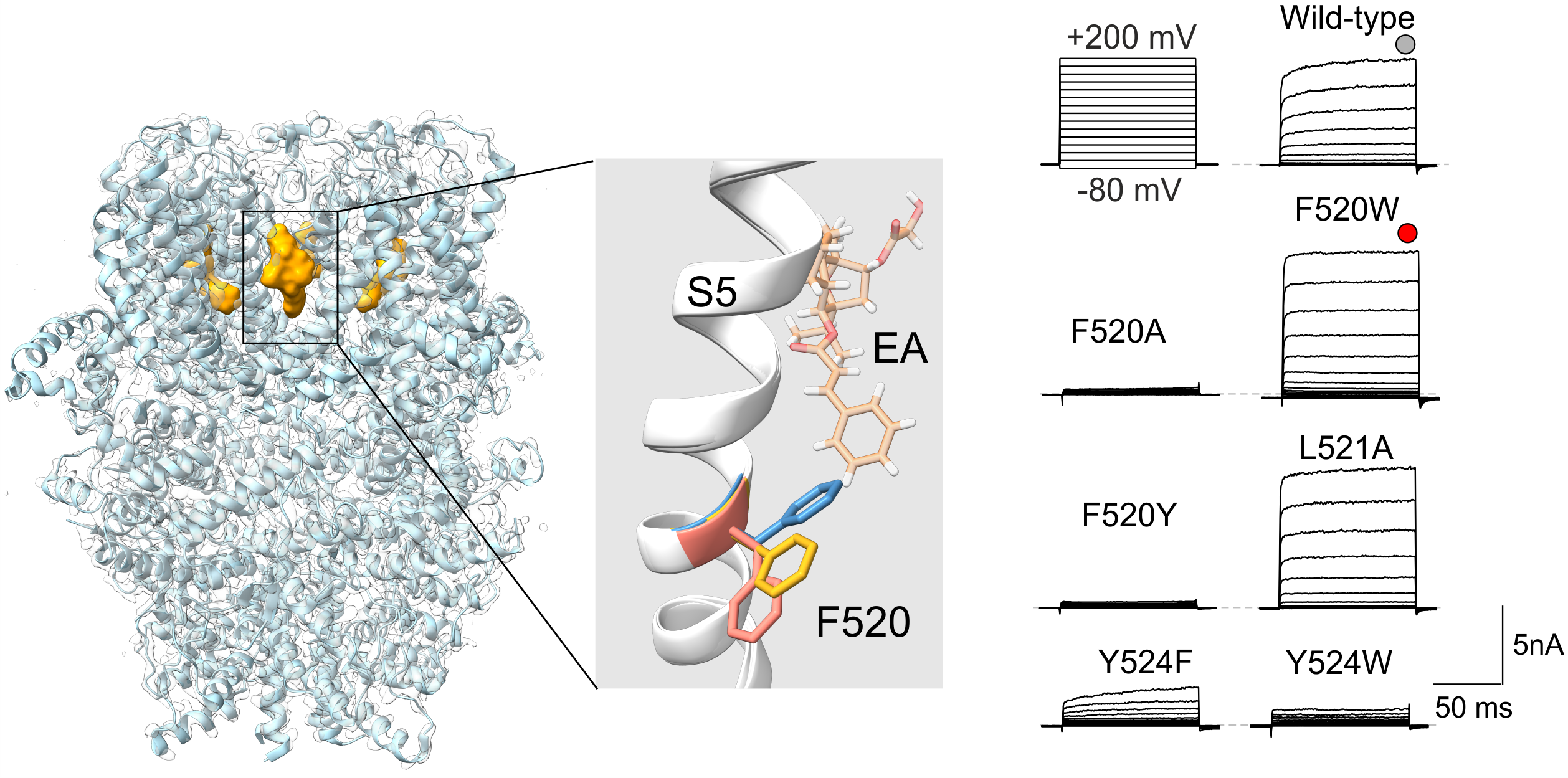
This work builds on an international collaboration between the Laboratory of Cellular Neurophysiology at IPHYS and Robin S. Bon’s team at the University of Leeds. Using cryo-electron microscopy, the researchers resolved structures of the human TRPC5 channel in different conformational states and with varying numbers of bound Englerin A molecules. The authors show that Englerin A binds to a specific site located between two subunits of the TRPC5 channel, occupying a position normally held by a membrane lipid. Detailed functional analysis using electrophysiological methods further confirmed that mutations of amino acids surrounding the binding site alter the sensitivity of TRPC5 to Englerin A and thus its ability to be activated.
Implications for drug development
Structural maps of the Englerin A binding site on TRPC5 will enable the rational design of new, highly selective compounds, with potential as therapeutics for a range of diseases associated with these channels’ function, including cardiometabolic diseases, neurological disorders, and cancer. The authors also demonstrate that the same site is utilised by other known modulatory compounds (e.g., Pico145), which will help to better understand how these regulatory molecules act on TRPC4/5 channels.
Reference: Porav S. A., Ptakova A., Bauer C. C., Hammond K. L. R., Beech D. J., Vlachova V., Muench S. P., Bon R. S.: (-)-Englerin A binding to human TRPC5 exposes an aromatic interaction network in channel activation. Nature Communications 17:5259 (2026). IF = 18.1; DOI: 10.1038/s41467-026-71840-y
Figure legend: Changes in the aromatic landscape around phenylalanine 520 (F520) mediate TRPC5 channel gating. Structure of the human TRPC5 channel, as seen from the side, with four molecules of Englerin A (EA) shown as orange surfaces. In detail, dynamics of F520 in TRPC5 activation by EA. Superimposition of the fifth transmembrane helix S5 from the three structures (PDB ID: 9RRF, 9RRM, 9RRU) showing different orientation of F520. Right, mean current traces in response to voltage steps recorded from HEK293T cells expressing indicated constructs of TRPC5.